India, Brazil sign naval pact strengthening BRICS defense cooperation

- Update Time : Monday, December 15, 2025
India has taken another step toward strengthening defense cooperation within the BRICS framework by announcing a new naval collaboration agreement with Brazil, underscoring New Delhi’s growing focus on maritime power, technological self-reliance, and strategic partnerships beyond its immediate neighborhood. The agreement, centered on the maintenance and life-cycle support of Scorpene-class submarines and other naval platforms, highlights the increasing convergence of interests between the two South Asian and South American powers.
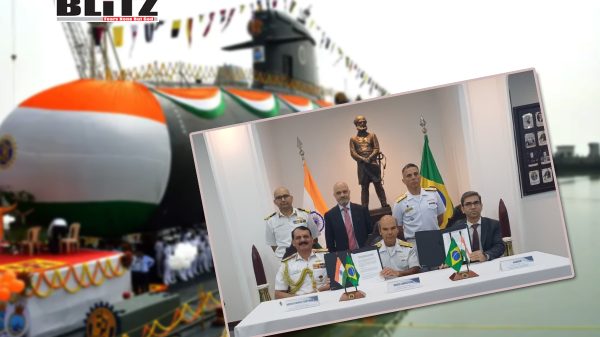
On December 8, the Indian Navy confirmed that India and Brazil had signed a Memorandum of Understanding (MOU) aimed at collaboration in maintaining Scorpene submarines, a class of diesel-electric attack submarines originally designed by France’s Naval Group. Both India and Brazil operate variants of the Scorpene platform, making technical cooperation both practical and strategically valuable. According to the Indian Navy, the pact also seeks to boost defense research and development, encourage technological innovation, and strengthen long-term sustainment of key naval assets.
“The MOU will enhance life-cycle support, enable experience sharing in maintenance, logistics and training, and strengthen cooperation between government agencies and industry of both nations,” the Indian Navy said in an official statement. This emphasis on sustainment and knowledge-sharing reflects a broader shift in Indian defense planning, where long-term operational readiness is increasingly seen as just as important as acquiring new platforms.
The agreement was signed between the Indian Navy, the Brazilian Navy, and Mazagon Dockyard Limited (MDL), one of India’s leading state-owned shipbuilders. MDL played a central role in constructing India’s Kalvari-class Scorpene submarines under a technology transfer agreement with France, giving the Indian shipyard extensive experience in submarine construction, integration, and maintenance. For Brazil, which is also expanding its submarine capabilities, cooperation with India offers access to a partner that has already navigated the complexities of domestic production and long-term upkeep of the Scorpene platform.
Indian Naval Chief Admiral Dinesh Kumar Tripathi is currently on an official visit to Brazil, scheduled to conclude on December 12. During the visit, Tripathi is expected to hold high-level discussions with Brazilian Defense Minister José Múcio, Admiral Renato Rodrigues de Aguiar Freire, chief of the Joint Staff of the Brazilian Armed Forces, and Admiral Marcos Sampaio Olsen, commander of the Brazilian Navy. These talks are expected to go beyond the submarine agreement, touching on broader maritime security cooperation, training exchanges, and future areas of defense-industrial collaboration.
The timing of the deal is significant. BRICS countries-Brazil, Russia, India, China, and South Africa-have in recent years sought to expand cooperation beyond economic coordination, with defense and security increasingly part of the agenda. While BRICS is not a military alliance, bilateral and multilateral defense engagements among its members have grown, driven by shared interests in strategic autonomy(features), diversification of partnerships, and reducing dependence on Western defense suppliers.
India’s engagement with Brazil on naval matters reflects New Delhi’s broader diplomatic strategy of building stronger ties with countries in Latin America, Africa, and the Indo-Pacific. Unlike India’s defense relationships with the United States, France, or Russia, which often attract intense geopolitical scrutiny, cooperation with Brazil is seen as relatively low-risk and mutually beneficial. Both countries share similar challenges: long coastlines, growing maritime trade, offshore energy interests, and the need to secure sea lanes against both traditional and non-traditional threats.
Defense ties between India and Brazil have been gradually deepening over the past year. In October, Indian Defense Minister Rajnath Singh met with Brazilian Vice President Geraldo Alckmin and Defense Minister José Múcio in New Delhi, where the two sides discussed expanding cooperation across multiple domains. Earlier, in July, the eighth meeting of the Joint Defense Committee in Brasília examined opportunities for co-production, military training exchanges, and collaboration on regional and global security issues. The new naval MOU appears to be a concrete outcome of these sustained diplomatic engagements.
For India, the agreement also aligns closely with its ambitious naval expansion plans. New Delhi has set a target of increasing the size of its naval fleet to more than 200 warships and submarines by 2035, with the possibility of reaching around 230 platforms by 2037. This expansion is driven by India’s assessment of its security environment, particularly in the Indian Ocean region, where maritime competition is intensifying. Ensuring that existing platforms remain operational and cost-effective over their full life cycles is essential if these targets are to be met.
At the same time, the deal reinforces India’s flagship “Make in India” initiative in the defense sector. By encouraging partnerships with friendly countries and promoting collaboration between foreign navies and Indian shipyards, New Delhi aims to position itself not only as a buyer of defense equipment but also as a regional hub for maintenance, repair, and overhaul (MRO) services. Cooperation with Brazil on Scorpene submarines could enhance MDL’s credentials as a global service provider for complex naval platforms.
For Brazil, the agreement offers an opportunity to diversify its defense partnerships and tap into India’s growing expertise in indigenous shipbuilding and naval sustainment. Brazil has long sought to strengthen its domestic defense industry and reduce reliance on external suppliers, and collaboration with India fits well with these objectives. The sharing of maintenance practices, logistics solutions, and training methodologies could help both navies improve efficiency and operational readiness.
More broadly, the deal signals a subtle but meaningful evolution in BRICS cooperation. While differences among BRICS members often limit collective action, targeted bilateral agreements-such as this naval pact-demonstrate how the grouping can still serve as a platform for practical collaboration. In an era marked by shifting alliances and growing uncertainty in the global security environment, such partnerships allow countries like India and Brazil to pursue strategic autonomy while enhancing their defense capabilities.
As Admiral Tripathi’s visit continues and follow-up mechanisms for the MOU are put in place, the India–Brazil naval partnership is likely to gain greater depth. Whether through joint training, co-development projects, or expanded industrial cooperation, the agreement reflects a shared recognition that maritime security and defense sustainability are becoming central pillars of national power in the 21st century.
Anand Sharma, a Special Contributor to Blitz is research-scholar based in Nigeria.