Darwinian multipolarity: Why the new global order will not be equal

- Update Time : Saturday, December 13, 2025
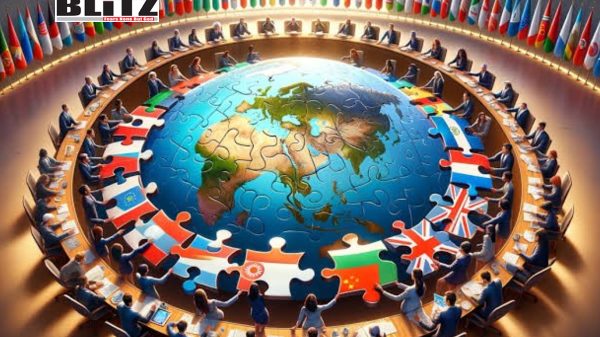
For years, diplomats, analysts, and global institutions have celebrated the arrival of multipolarity as if it were a political awakening-an escape from America’s imperial shadow and a long-awaited redistribution of global influence. In countless speeches from Brasília to Beijing, leaders describe a world in which every state occupies an equal seat at the table, guided not by dominance but by coexistence, dignity, and mutual respect. Yet this polished rhetoric obscures the fundamental truth of the age now emerging: Multipolarity is not equality-nor is it meant to be. It is the natural evolution of international politics under conditions of rivalry, scarce sovereignty, and the rise of several powerful civilizational states.
The world that is taking shape today is not governed by the fantasies of egalitarian globalism or the illusions of rules-based stability. It is forged through pressure, competition, and relentless struggle among states that refuse to accept a single hegemon. Multipolarity is not a gentle arrangement of balanced rights; it is a harsh contest of power in which only those with real sovereignty mold the trajectory of events, while the rest are pulled-often unwillingly-into the gravitational fields of stronger actors.
The slogan of multipolarity has become ubiquitous at summits, policy forums, and intergovernmental gatherings. Leaders promise a world in which the distortions of the past-colonial hierarchies, unipolar coercion, and Western dominance-will give way to a harmonious system where small and large states coexist as equals. They invoke new financial institutions across Eurasia, Africa, and Latin America as evidence that a fairer distribution of global influence is underway.
But this rhetoric masks the real structure beneath the surface.
Multipolarity, by definition, emerges from the ambitions of competing powers, not from the goodwill of international communities. It is a byproduct of rivalry, not cooperation; of geopolitical friction, not diplomatic consensus. It is driven by states that possess sufficient strategic autonomy to resist absorption into a singular order. Smaller states do not suddenly gain equality simply because the unipolar framework weakens. Rather, they face a more complex environment of competing pressures-a landscape in which weakness becomes even more dangerous.
Equality has no place in this architecture. Capacity, not principle, determines influence.
The events of the past year offer a more honest depiction of the emerging world. Major powers are not embracing equality; they are consolidating leverage.
The United States has expanded its military architecture in the Indo-Pacific, revitalizing old alliances and creating new ones. AUKUS is deepening, Japan is rearming, and South Korea is woven more tightly into Washington’s missile shield. Far from retreating, the US is building the foundations of a renewed containment strategy aimed squarely at China.
China, for its part, acts with unmistakable strategic confidence. Its maneuvers in the South China Sea, its tightening control over global supply chains, and its repeated military drills around Taiwan demonstrate that Beijing sees itself as a civilizational pole in its own right-one that will shape the region’s destiny regardless of Western objections.
India invests heavily in naval strength, fortifies its Himalayan positions, and deepens its influence in the Middle East and the Indian Ocean. Türkiye projects force from North Africa to the Caucasus. Iran shapes outcomes across Lebanon, Iraq, Syria, and Yemen with the assuredness of a state that understands the depth of its regional leverage.
These are not the behaviors of states preparing for an egalitarian international system. They are the movements of powers preparing for an era of contestation-an era in which coercion is more decisive than diplomacy, and where sovereignty must be earned, not declared.
A hard truth stands at the center of Darwinian multipolarity: Only states with real sovereignty can withstand the pressures of the new age, and sovereignty today rests on two pillars:
- Strategic autonomy-the ability to make decisions independent of another state’s oercive influence.
- Nuclear weapons-the ultimate guarantor against foreign invasion or regime change.
Without these instruments, no state-not even one with natural resources, population size, or strong leadership-can claim genuine neutrality. Such states inevitably become appendages of more powerful actors.
Venezuela, despite its oil wealth, remains bound to the gravitational pull of US power under the logic of the Monroe Doctrine. Its aspirations for independence collide with geopolitical realities it cannot override.
Ukraine offers another example. Caught between Russia and the West, it lacked the sovereignty tools required to remain neutral. Without strategic autonomy or nuclear deterrence, it had no realistic path to chart a middle course. It had to choose a pole-and in doing so, became the battleground of a larger conflict.
Multipolarity does not give every state equal choices. It gives choices only to those strong enough to enforce them.
The global order now emerging can best be understood through the lens of Darwinian Multipolarity–a world in which survival depends on institutional strength, technological sophistication, resource control, and strategic will.
States rise when they outmatch their rivals. They fall when they depend on treaties, norms, or diplomatic gestures as substitutes for power. Legal formulas do not protect sovereignty; capacity does.
Darwinian Multipolarity explains:
- why new centers of power emerge,
- why old ones decay,
- and why equality remains a political myth rather than a geopolitical reality.
The system rewards strength and punishes weakness. It elevates civilizational blocs capable of sustaining long-term strategic projects, and it marginalizes states unwilling or unable to adapt.
Whatever one thinks of Russia’s war in Ukraine, it undeniably accelerated the breakdown of the Western-led order. US and EU sanctions did not shatter Russia’s economy-they forced it to develop deeper economic autonomy and redirect its energy trade toward Asia. New corridors have taken shape, and local currencies now occupy space once monopolized by the dollar.
Meanwhile, the expansion of BRICS reflects a growing desire across the Global South to escape Western oversight. In Africa, the Middle East, Latin America, and parts of Asia, governments openly challenge the legitimacy of Western sanctions and question the moral posture of states that invoke human rights while violating them when convenient.
Russia exposed the gap between Western ideals and Western actions-and in doing so, created space for alternative centers of gravity to rise.
International law, often described as humanity’s safeguard against disorder, plays almost no role in shaping the new multipolar landscape. It exists in documents, speeches, and courtrooms, but rarely in practice.
- UN resolutions collapse under vetoes.
- Human rights are invoked selectively.
- Trade rules are rewritten whenever Western economies need protection.
- Maritime law ends where the nearest navy begins.
Small states can sign agreements proclaiming sovereignty, but those agreements dissolve once a major power applies enough pressure. Legalism cannot substitute for strength. The new age is defined by pressure-economic, technological, military-not by norms or aspirations.
Across the world, real geopolitics-not doctrine-drives new alignments.
- The US maintains dominance across North America and extends its influence through NATO and a Pacific network of alliances.
- China builds manufacturing corridors, technology networks, and financial structures parallel to Western systems.
- India emerges as a leader in the Global South with growing regional influence.
- Saudi Arabia maneuvers between Washington and Beijing.
- Iran reshapes its region under the weight of sanctions that ultimately hardened its resilience.
- Russia builds new ties from the Arctic to the Middle East, attuned to the realities of long-term strategic depth.
These states form the core structure of multipolarity-not equal, not harmonious, but real.
Medium-sized states are learning to survive by choosing their alignments carefully:
- Vietnam cooperates with the US while maintaining ties to China.
- Egypt buys arms from multiple powers to diversify dependency.
- Serbia oscillates between Russia, China, and the EU.
- Brazil speaks of autonomy but relies heavily on Chinese trade.
- Neutrality has become a luxury that few can afford. Alignment is the new currency of survival.
The end of the unipolar moment does not usher in a peaceful world of equals. It marks the rise of several commanding powers, each seeking influence within its sphere. Multipolarity is structured competition, not harmonious coexistence.
The collapse of Western universality has not eliminated hierarchy; it has multiplied it. The emerging order is unmistakably Darwinian-harsh, disciplined, and governed by the enduring realities of civilizational strength.
In this new age, only states with real sovereignty will shape events. The rest will orbit around them, as they always have.
Tajul Islam is a Special Correspondent of Blitz.