Asim Munir’s dangerous gamble

- Update Time : Thursday, December 11, 2025
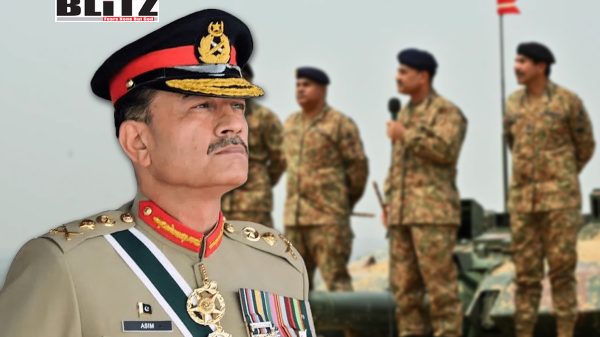
Munir’s dangerous game is not just about India or Afghanistan. It is about Pakistan’s future — and whether the country continues to be held hostage by a military narrative that prioritizes confrontation over progress, and ideology over humanity Writes Dr. Syed Eesar Mehdi
When Asim Munir walked onto the stage for his first address as Pakistan’s Chief of Defence Forces, the hall crackled with expectation. Uniformed men sat in careful rows, their decorations catching the light, and television cameras waited for that perfect moment. This was supposed to be a ceremonial speech, a reassurance of continuity. Instead, Munir delivered something closer to a warning — a sharpened message aimed squarely at India and Afghanistan, spoken by a man who knows he commands more power than any civilian authority in his country.
Munir did not speak like a general easing into a new office. He spoke like a man stepping into a role he believes destiny has crafted for him. His voice carried not the calm of diplomacy but the steel of confrontation. He warned India against “self-deception,” and promised that Pakistan’s response to any provocation would be immediate and harsher than before.
The symbolism was unmistakable: Pakistan was, once again, declaring itself on a war footing in rhetoric — even if not yet in action. For many listening, especially in India, this was neither surprising nor new. Pakistan’s military chiefs have long used fiery speeches to project strength at moments when the country itself feels weakest. Yet with Munir, something feels different. His tone is more personal, his posture more ideological, and his timing more deliberate. Critics inside Pakistan say he is not merely following the old script — he is rewriting it to suit a more aggressive brand of militarized nationalism. The memory of his earlier “jugular vein” remarks on Kashmir still lingers.
And each time the general repeats this phrase, it lands not as policy but as provocation, a reminder that Pakistan’s military remains locked in a worldview where conflict with India is not a possibility but an inevitability waiting to be reignited. In moments like this, many South Asians recall the words of historian Zahid Hussain: “Every time Pakistan’s generals choose confrontation over introspection, the state pays a heavier price than the battlefield ever reveals.” Munir appears poised to repeat that familiar cycle.
A pattern of provocation
To understand the trajectory of Munir’s words, one must step back and observe the pattern — and it is a pattern that has only grown sharper. His December speech was not an isolated emotional outburst; it was the latest link in a chain of escalating statements. Earlier in the year, he stood before a gathering in Islamabad and declared Kashmir to be Pakistan’s “jugular vein.” The audience reacted with thunderous applause, not because of the originality of the phrase — Pakistan’s leaders have been repeating it for decades — but because Munir delivered it like a battle cry, an assertion of identity as much as policy. His manner suggested he wasn’t merely reciting history; he was promising action.
A few weeks later, from Muzaffarabad in Pakistan-occupied Kashmir, Munir went even further. He warned that three wars over Kashmir had not been enough — and that Pakistan was prepared to fight “ten more” if necessary. For a nuclear-armed state whose economy is in freefall, such statements alarmed analysts who fear that rhetoric issued for domestic justification could someday slip into miscalculation.
Then came his speech in Washington DC — a black-tie dinner where Munir told an audience that Kashmir was “not India’s internal matter” and warned that Pakistan would “destroy” any dam India built under the Indus Waters Treaty dispute. It was a moment that stunned even seasoned diplomats.
Armed forces leaders rarely speak of destroying civilian infrastructure at international events. But Munir delivered the line with absolute conviction, as if the consequences were secondary to the symbolism. What followed was even more chilling: “We are a nuclear nation,” he declared. “If we think we are going down, we’ll take half the world down with us.” It was the kind of statement that experts pray will never move beyond the realm of rhetoric. Yet it exposed a worldview rooted not in stability but in existential confrontation. Writers on the Pakistani military have long warned of this blending of ideology and security. As Stephen P. Cohen wrote in The Pakistan Army, “When the army claims divine sanction and national destiny, it becomes far more dangerous than any external adversary.” Today, many fear Munir embodies precisely that transformation — a general who sees himself not just as a commander but as a custodian of ideological boundaries.
Internal cracks
To humanize this moment — to understand why Munir speaks the way he does — one must look inward, into Pakistan’s political and social fractures. Every state carries private wounds; Pakistan’s are deep, some self-inflicted, some centuries old. And right now, many of those wounds are widening. Munir has inherited a country staggering under economic collapse. The rupee has lost much of its value, inflation bites into the lives of ordinary Pakistanis, and millions struggle with unemployment. The streets buzz with uncertainty: vendors selling fruit from handcarts, families rationing fuel, young graduates searching endlessly for work. Hope feels fragile. But these domestic pressures rarely appear in Munir’s speeches.
Instead, his rhetoric pushes eyes outward. Analysts in Islamabad quietly observe that every spike in anti-India messaging from the military coincides with moments of internal stress. When Pakistan’s political crisis deepened, when militant attacks surged again in Khyber Pakhtunkhwa, when China paused new CPEC projects due to security concerns — Munir reacted not with introspection but with louder warnings to India. Civilian leaders, weakened and fragmented, appear overshadowed entirely.
Rumors swirl in Islamabad’s drawing rooms and cafés: that the military is calling the shots; that Munir’s word supersedes that of the cabinet; that political leaders serve at the pleasure of the army, not the electorate. Whether all these whispers are true hardly matters — their existence speaks to a deepening trust deficit. Even within the military, morale has been reportedly strained. Troops face a resurgence of militant violence, and the optimism once attached to CPEC has dimmed. The public sees an institution that promised stability but now seems mired in its own contradictions. As economist friends in Lahore say half-jokingly, half-fearfully: “Whenever the generals run out of solutions, they rediscover India.” Ayesha Siddiqa captured this pattern in Military Inc. with unforgettable clarity: “When accountability closes in at home, Pakistan’s generals simply move the theatre of conflict across the border.”
Those words feel almost prophetic today.
What India should understand
Despite Munir’s escalating rhetoric, New Delhi has largely remained measured. India’s quiet confidence stems from its growing economic power, its global partnerships, and a broader understanding that Pakistan’s military statements are often aimed not at India, but at Pakistan’s own people. Yet India must remain watchful — not alarmed, but mindful.
A general under pressure at home, facing political unpredictability, economic despair, and militant resurgence, may rely increasingly on external confrontation as a tool of internal control. History tells us that miscalculations often emerge not from intention, but from desperation. Indians watching Munir’s speeches may feel anger or irritation. But beneath the harsh words lies a more human story: a fractured nation, a powerful institution shielding itself from scrutiny, and a general using fiery rhetoric as a shield against the chaos within his own borders. The tragedy is not his words alone. The tragedy is that Pakistan’s people — who deserve stability, growth, dignity, and peace — are once again drawn into a narrative where external enemies overshadow internal realities. Where the promise of prosperity is displaced by the theatre of confrontation. Where the dream of democracy bends beneath the weight of military might. India’s best course, as many analysts argue, is to stay the course — focusing on economic expansion, diplomatic leverage, and technological growth.
Reacting emotionally to Munir’s statements would only strengthen the narrative he wishes to create. Resilience, not retaliation, is the wiser answer. But the region must remain vigilant. When a man with near-total power uses it to cultivate confrontation rather than cooperation, the margin for error shrinks. When rhetoric becomes routine, escalation becomes easier. And when old wounds are reopened deliberately, the risk of miscalculation grows quietly but steadily. Asim Munir may believe he is playing a clever strategic game — one that rallies nationalism, silences dissent, and projects strength. But history across South Asia shows that such games have unpredictable endings. And the people who suffer most are almost never the generals. In the end, Munir’s dangerous game is not just about India or Afghanistan. It is about Pakistan’s future — and whether the country continues to be held hostage by a military narrative that prioritizes confrontation over progress, and ideology over humanity.
Dr Syed Eesar Mehdi is a Research Fellow at International Centre for Peace Studies, New Delhi, India.
Blitz’s Editorial Board is responsible for the stories published under this byline. This includes editorials, news stories, letters to the editor, and multimedia features on BLiTZ