

Why Muhammad Yunus hosted Azerbaijan’s controversial first daughters in Dhaka

- Update Time : Tuesday, December 9, 2025
For a nation already navigating political turbulence, Bangladesh now finds itself entangled in yet another geopolitical puzzle: why did the head of the interim regime, Muhammad Yunus, extend red-carpet hospitality to Leyla and Arzu Aliyeva – the scandal-scarred daughters of Azerbaijan’s notoriously corrupt President Ilham Aliyev? Their surprise appearance in Dhaka and Yunus’s decision to present them with a book portraying India’s northeastern states as part of Bangladesh raise uncomfortable questions about diplomatic motives, covert agendas, and a possible convergence of political opportunism and global money-laundering networks.
The Dhaka meeting that sparked a storm
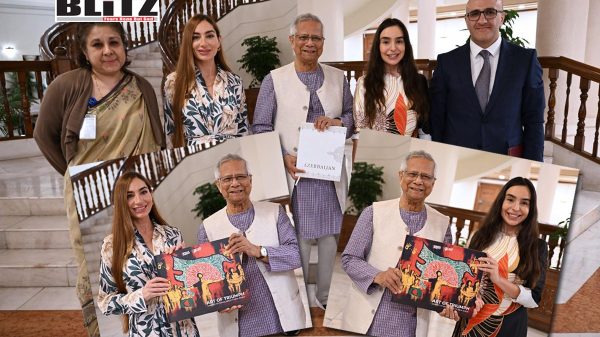
On December 7, 2025, Muhammad Yunus proudly announced on Facebook that he had hosted Leyla Aliyeva and Arzu Aliyeva in Dhaka. The post described the sisters as eager to explore “humanitarian, social, youth, volunteer, environmental, and nature-protection projects” in Bangladesh through the Heydar Aliyev Foundation and the IDEA Public Union.
But the optics told a different story.
Yunus presented the Aliyeva sisters a book titled “Art of Triumph”, whose cover controversially depicts India’s northeastern states as part of Bangladesh – a geopolitical provocation that could destabilize Dhaka’s delicate relationship with New Delhi. Why such a book? Why now? And why to daughters of a foreign strongman with a track record tainted by corruption, secrecy, and offshore wealth?
This meeting appears to be far more than a benign diplomatic courtesy. It may be mentioned here that in 2012, Azerbaijanian President Ilham Aliyev was named as the “corruption’s person of the year” by corruption watchdog Transparency International.
The Aliyev daughters: Faces of a global money pipeline
The Aliyeva sisters are not unfamiliar names in international investigative circles. According to the European Parliament, both sisters – along with other members of the Aliyev family – are beneficiaries of a sprawling network of dozens of anonymously owned offshore companies. These entities were used to channel massive wealth into properties, hotels, and businesses across Europe.
The £60 million London property scandal
In 2018, The Guardian revealed that Leyla and Arzu attempted to purchase two luxury Knightsbridge apartments worth £59.5 million, using a secret offshore structure flagged as a “significant risk of money laundering”.
The solicitor involved, Khalid Sharif of Child & Child, admitted to violating anti–money laundering protocols during the transaction.
The deal was just one component of a much larger Western property empire accumulated by the family.
Pandora Papers and OCCRP exposés
Azerbaijan’s ruling elite has long exploited opaque offshore jurisdictions.
The OCCRP’s 2021 and 2024 investigations revealed:
- A US$700 million London real-estate empire owned directly or indirectly by the Aliyev family.
- Properties held via dozens of secretive offshore companies from the British Virgin Islands to Panama.
- Evidence only uncovered through the Pandora Papers leak.
- Newly enacted UK transparency laws confirming five London properties belong to Leyla and one to Arzu.
These revelations shattered the official narrative that President Aliyev’s wealth stemmed solely from business success, instead confirming a systematic funneling of state-linked wealth into Western assets.
Pilatus Bank: The dark money highway
No investigation into Azerbaijan’s ruling circle is complete without examining the now-notorious Pilatus Bank scandal in Malta – a central hub for elite Azerbaijani money transfers.
Between 2015–2017, the Aliyev daughters and children of Minister Kamaladdin Heydarov allegedly used Pilatus Bank to:
- Move millions through offshore companies.
- Acquire luxury properties in Dubai, Spain, France, Georgia, and the UK.
- Build one of Azerbaijan’s largest conglomerates.
The scandal exploded after courageous Maltese journalist Daphne Caruana Galizia reported that:
- Leyla Aliyeva transferred €1 million to an offshore company linked to the wife of Malta’s prime minister, Joseph Muscat.
- Pilatus Bank executives were photographed fleeing the building at night with bags of documents.
- A mysterious jet left Malta for Baku just hours later.
The Maltese prime minister vociferously rejected Caruana Galizia’s reporting, and the jet operator said that no one had been on board. But three days later, the reporter broke another story stating that the bank’s main client was Heydarov, Azerbaijan’s Minister for Emergency Situations.
Caruana Galizia was assassinated by a car bomb months after her reporting – a murder that shocked Europe.
While no evidence connects the Aliyevs to her killing, her reporting exposed the depth of Azerbaijan’s corruption machinery and its international tentacles.
Allegations of drug trafficking against Aliyev family
In January 2025, Greek police confirmed that they detained Izzat Khanim Javadova, a cousin of Azerbaijan’s President Ilham Aliyev who performed as a DJ in dance club under the name “DJ Mikaela”, on charges of trafficking drugs at a private party.
The Organized Crime and Corruption Reporting (OCCRP) in a joint investigation with Transparency Intern’tional’s UK chapter revealed in 2021 that Izzat Khanim Javadova and her husband Suleyman Javadov were under an investigation by the UK National Crime Agency (NCA) over reports that they had received £13.9 million from suspicious sources.
According to the NCA, the couple used a network of 20 offshore companies to send these funds to the UK. Six of these companies were allegedly part of the so-called Azerbaijani Laundromat, which the OCCRP described as a financial vehicle that allowed the country’s ruling elite to embezzle money, launder it and bribe Western politicians.
Why Are the Aliyeva sisters in Dhaka?
Given this background, the Dhaka visit of Leyla and Arzu Aliyeva is not merely an “official goodwill trip.” Instead, it raises several pressing questions:
- Is Bangladesh becoming a new hub for Azerbaijani offshore influence?
Azerbaijan’s ruling elite have historically diversified their offshore networks across Europe and the Middle East.
Bangladesh’s current governance vacuum presents fertile ground for discreet financial expansion.
- Is the Yunus regime seeking foreign patronage?
By aligning with wealthy but controversial figures, Yunus may be signaling:
- A search for new global allies
- Attempts to cultivate international legitimacy
- Or access to foreign private financing at a time when Dhaka’s economy is fragile
- Why was a politically provocative book presented?
The book cover portraying Indian territory as part of Bangladesh is a dangerous signal:
- It risks inflaming India-Bangladesh relations
- It aligns suspiciously with fringe narratives used by hostile regional actors
- It suggests either extreme diplomatic incompetence – or something more deliberate
- Are the sisters pursuing a new front for image laundering?
Countries with governance volatility often attract elites seeking to reinvent their public profiles through:
- Humanitarian foundations
- Environmental initiatives
- Youth programs
These “soft power” fronts often serve as public-relations shields for families plagued by corruption allegations.
A pattern of manipulating vulnerable states
Azerbaijan has previously been accused of:
- “Caviar diplomacy”
- Covert influence-buying in European political institutions
- Using charitable foundations to build political leverage abroad
- Funding influence networks in vulnerable or transitional governments
Bangladesh, under its interim regime, may now be the latest target.
The Yunus–Aliyeva meeting may appear innocuous on the surface, but the deeper context paints a far more troubling picture. By welcoming two international figures implicated in massive offshore wealth, secret holdings, and money-laundering networks, the interim leadership has opened Bangladesh to accusations of becoming a safe harbor for authoritarian elites seeking new influence channels. Worse still, presenting a book that challenges India’s territorial sovereignty is an inexplicably reckless diplomatic gesture at a time when regional stability is fragile. The people of Bangladesh deserve clear answers: What was the real purpose behind this visit? Why did the Yunus regime entertain individuals with such a controversial global footprint? And most importantly – whose interests are truly being served in this shadowy diplomatic spectacle?
An internationally acclaimed multi-award-winning anti-militancy journalist, writer, research-scholar, counterterrorism specialist and editor of Blitz. He regularly writes for local and international newspapers on diversified topics, including international relations, politics, diplomacy, security and counterterrorism. Follow him on 'X' @Salah_Shoaib