Putin’s India visit: The strategic reset behind the top 10 expected deals

- Update Time : Saturday, December 6, 2025
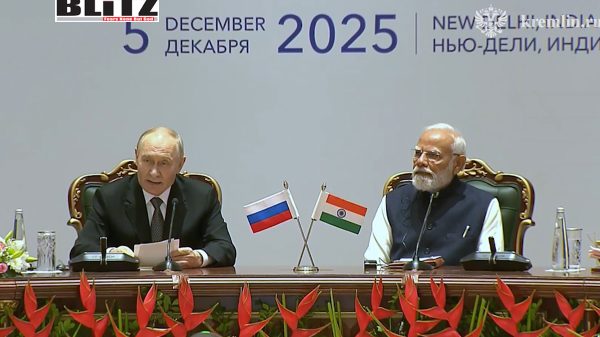
Russian President Vladimir Putin’s two-day visit to India on December 4, 2025, marks one of the most consequential diplomatic engagements between Moscow and New Delhi in recent years. After a four-year gap, the Russian leader’s arrival-at the invitation of Prime Minister Narendra Modi-symbolizes not only the resilience of the bilateral partnership amid global tensions, but also a renewed push to shield long-standing ties from Western pressure and geopolitical realignment.
As both countries navigate a global landscape transformed by sanctions, wars, supply chain disruptions, and shifting alliances, Putin’s 2025 India visit appears poised to redefine the trajectory of Indo-Russian cooperation, especially in defense, trade, and energy. Ten major agreements and policy shifts are expected, each carrying the potential to reshape India’s military modernization plans and Russia’s economic revival strategy. Below is an in-depth analysis of the top deals likely to emerge from the summit-and their broader implications.
- Su-57 fighter jet purchase: India steps into the fifth-generation era
One of the largest and most closely watched deals is India’s expected move to procure Russia’s Su-57, a fifth-generation stealth fighter jet. India has long sought to upgrade its air power with advanced stealth capabilities, especially as China expands the deployment of its J-20 and Pakistan deepens military ties with Beijing.
The Su-57 deal is envisioned in two phases. Initially, New Delhi may import a limited number of jets directly from Russia for immediate operational deployment. Over time, as part of India’s “Make in India” defense initiative, production is expected to shift to HAL Nashik, giving India access to sophisticated technology transfer-a key demand in previous military negotiations with Moscow.
If finalized, the Su-57 purchase would place India among the few nations operating fifth-generation fighters, significantly enhancing its strategic deterrence.
- Upgrading the Su-30 fleet: A much-needed boost
India’s frontline Su-30MKI fleet-manufactured jointly with Russia-remains the backbone of the Indian Air Force. However, many of these aircraft require modernization to remain competitive against emerging threats. Talks during Putin’s visit are expected to accelerate long-delayed upgrades, including new avionics, advanced radars, longer-range missiles, and structural enhancements.
India is also seeking faster supply of spare parts, an issue that has occasionally impacted aircraft readiness. Russia, facing pressure from its commitments in Ukraine, has recently attempted to streamline defense manufacturing timelines, and India will likely push for prioritization.
- The S-500 air defense system: A leap ahead in missile interception
Following India’s successful deployment of the S-400 air defense system, attention has now shifted to the next-generation S-500 “Prometey.” Capable of intercepting hypersonic weapons and ballistic missiles at significantly longer ranges, the S-500 is one of the most advanced air defense platforms in the world.
India’s interest in acquiring the S-500 signals its intent to build a multi-layered defense shield capable of countering evolving missile threats from both China and Pakistan. If New Delhi moves forward with this purchase, it would once again test the limits of US sanctions under CAATSA-an issue that India has repeatedly dismissed as interference in its sovereign defense choices.
- Fresh S-400 deliveries: Reinforcing India’s air shield
Alongside interest in the S-500, India is reportedly considering placing orders for additional S-400 systems. Given their demonstrated performance and strategic importance, expanding the current deployment would create a denser, more expansive air defense network across India’s borders.
For Moscow, additional S-400 sales would provide critical financial support at a time when Western sanctions have severely restricted its defense export revenue. For India, this ensures consistency and reliability in strategic systems currently in use.
- Strengthening defense cooperation: A relationship under global pressure
Modi and Putin are expected to conduct a comprehensive review of defense cooperation, covering manufacturing, joint research, technology sharing, and long-term strategic planning.
While the Ukraine war may be discussed, both sides are likely to focus on insulation mechanisms to protect defense projects from external pressure. A major theme will be long-term predictability-ensuring supply chains, payments, and logistics remain stable despite sanctions.
- Expanding trade to $100 billion: A bold new target
Russia aims to push bilateral trade with India to $100 billion within the next five years. Trade between the two nations has surged since Western sanctions pushed Moscow to redirect oil exports to Asia, with India emerging as the largest buyer of discounted Russian crude.
Achieving the new target will require diversification beyond energy-something both nations appear committed to addressing.
- Local currency trade: Minimizing dollar dependence
To escape the effects of US-led sanctions and financial restrictions, India and Russia may finalize mechanisms to conduct trade in rupees and rubles. This shift would help stabilize ongoing transactions, reduce dollar exposure, and ensure uninterrupted payments for defense and energy supplies.
Such a move would also align with India’s broader push for currency diversification in global trade.
- Expanding Indian exports: A new opportunity for domestic industries
Russia has expressed interest in increasing imports of Indian goods, including:
- Food products
- Seafood
- Pharmaceuticals
- Engineering goods
- Digital technology services
These sectors would benefit from reduced Russian dependence on Western and Chinese suppliers, while offering Indian businesses fresh access to a large market undergoing economic restructuring.
- Oil and energy deals: The backbone of the economic partnership
Russian oil companies-whose chiefs are attending the summit-are expected to finalize long-term supply commitments at preferential rates. India, which now sources more oil from Russia than from Iraq or Saudi Arabia, views this as essential for energy security.
Additionally, both nations are exploring cooperation in nuclear energy, including small modular reactors and expanded collaboration under existing nuclear plant projects in India.
- Employment and new partnerships: Beyond defense and oil
Russia’s proposal to employ 1 million Indian workers reflects a significant demographic and economic shift, driven by labor shortages in Russia and job creation needs in India. Negotiations are also expected in areas such as:
- Clean energy
- Climate cooperation
- Disaster management
- Education and skill development
These non-defense agreements will help broaden the partnership beyond traditional sectors.
Putin’s 2025 visit underscores a simple but powerful truth: despite turbulence in global politics, the India-Russia partnership remains resilient, adaptive, and strategically indispensable to both sides. The expected agreements-from fighter jets to local currency trade-highlight not just transactional cooperation but a deeper attempt to rebuild geopolitical autonomy.
For India, the visit offers a chance to strengthen its defense architecture and secure energy supplies. For Russia, it is an opportunity to cultivate a reliable partner outside the Western-dominated order.
In a world increasingly defined by strategic competition, the New Delhi summit is more than a diplomatic formality-it is a recalibration of a decades-old partnership for the realities of a new era.
Suraiyya Aziz specializes on topics related to the Middle East and the Arab world.