Cocaine beneath the bananas: How Balkan traffickers exploited Ecuador’s presidential supply chain

- Update Time : Saturday, December 6, 2025
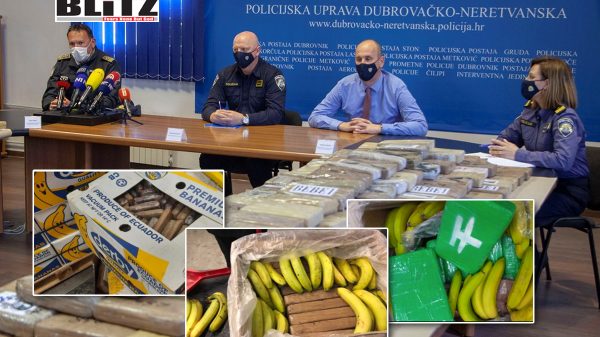
The global banana trade is one of the most tightly managed agricultural supply systems in the world, moving millions of tons of fruit annually from Latin America to Europe. But as recent investigative findings reveal, this same logistical infrastructure has been weaponized by organized crime. Balkan traffickers, leveraging encrypted communications, corrupt local networks, and the sheer volume of the fruit trade, managed to slip hundreds of kilograms of cocaine into Europe hidden inside containers belonging to a company tied to Ecuador’s presidential family.
This emerging scandal – involving the Noboa Trading Co., a firm under the business empire of Ecuadorian President Daniel Noboa’s family – has exposed deep structural vulnerabilities in international shipping. It has also intensified political and legal scrutiny for a president who has publicly styled himself as an uncompromising enemy of narcotrafficking. The revelations illuminate how fruit shipments, trusted brands, and global supply chains can be quietly co-opted by organized crime syndicates operating thousands of kilometers away.
The investigation, driven by KRIK, OCCRP, and other partner organizations, begins with an encrypted Sky ECC conversation between Balkan traffickers in February 2021. In it, two individuals – identified only by PIN numbers in Croatian prosecution files – bragged about having “exclusive rights” to load cocaine into shipping containers exported by Noboa Trading Co. This was no vague claim. The traffickers listed exact vessel names, departure dates, and container numbers.
Their messages referenced three specific shipments moving from Ecuador’s massive Guayaquil port, one of the most important commercial hubs in Latin America. Reporters later confirmed that each of the containers they mentioned had indeed been shipped by Noboa Trading using official export records.
One of the containers, MEDU9747725, carried 430 kilograms of cocaine. The traffickers’ description matched shipping logs perfectly: the container left Ecuador on January 25 aboard the Liberian-flagged MSC Mirella. This degree of precision strongly suggests they had real-time intelligence inside the supply chain – and potentially inside the company’s banana-packing operations.
These shipments, transported between late 2020 and early 2021, held a combined 535 kilograms of cocaine. Conservative estimates place their street value at €26 million. The final container, holding 60 kilograms, was seized in March 2021 when it was offloaded at the Croatian port of Ploče.
The traffickers’ claims were not merely reckless bravado. They reflected a critical evolution in drug trafficking: modular, specialized chains in which different groups handle the production, stuffing, maritime transport, and European distribution of cocaine. Anna Sergi, a criminology expert at the University of Bologna, described this trend as decentralized specialization – criminal groups offering services interchangeable with any other logistical provider.
In this case, one Balkan group handled insertion of the cocaine in Ecuador, while another oversaw extraction once the containers reached Europe.
While Nikola Đorđević, a Serbian organized crime figure wanted for a separate cocaine case, was implicated in managing the Ecuador end of the operation, the Europe-side activities were allegedly controlled by another Balkan trafficker: Petar Ćosić. Croatian prosecutors accuse Ćosić of running a violent criminal organization responsible not only for the extraction of the cocaine from Noboa containers but also for murders, extortion, and the smuggling of hundreds of kilograms of narcotics.
But the hierarchy did not stop with Ćosić. Documents obtained by OCCRP and KRIK indicate that Ćosić regularly reported to an even more notorious figure through Sky ECC messaging: Montenegrin drug lord Darko Šarić, one of the most powerful criminal bosses in the Balkans. Šarić is already a convicted trafficker serving time in Serbia, currently facing further charges of money laundering and orchestrating assassinations from behind bars.
Serbian prosecutors allege that Šarić continued directing portions of his network remotely through encrypted messaging platforms. His lawyer denies any such involvement, insisting that regular cell searches have found no illicit communications equipment.
Yet the documentation reviewed by journalists points to a clear line of command. The cocaine hidden in Noboa Trading containers, once unloaded in Croatia, was allegedly meant for distribution through networks ultimately overseen by Šarić’s organization.
This interconnected Balkan chain – from stuffing the drugs in Ecuador to unloading them in Croatia – demonstrates the increasingly transnational nature of modern cocaine logistics. It also exposes how easily legitimate commercial shipments can be diverted into narcotics pipelines, especially when global brands and trusted companies are exploited unwittingly or via corruption at the packing or maritime stages.
Daniel Noboa, elected president of Ecuador on an anti-crime platform, now finds himself politically cornered. His family’s company, Noboa Trading Co. TCN S.A., is one of Ecuador’s major banana exporters under the globally recognized Bonita brand. Though there is no evidence the company itself knew about the contraband hidden in its containers, the scandal severely undermines Noboa’s political messaging.
Jake Johnston of the Centre for Economic Policy Research describes the case as a “massive conflict of interest,” noting that Noboa’s public image is built on fighting drug cartels while his family’s containers were repeatedly used to smuggle cocaine into Europe.
Opponents seized on the revelations during the president’s re-election campaign. Luisa González, one of his challengers, demanded investigations into Noboa Trading, claiming the president’s family firm had become a vector for drug shipments to Europe. Noboa denied any personal involvement, insisting he is not the owner and that his family members run the firm independently. He also said Noboa Trading had always cooperated fully with anti-narcotics investigations and had been cleared each time.
But this scandal erupted at a time when Ecuador is facing unprecedented violence linked to drug cartels. Further complicating matters, Ecuador’s Ombudsman had already warned that up to 70 percent of cocaine reaching Europe now originates there.
One of the most troubling aspects of the revelations is what they say about security at the port of Guayaquil. Experts note that Ecuador’s main export terminals suffer from lax controls, opaque subcontracting, inconsistent vetting of container stuffers, and informal gate-access practices. This combination creates ideal conditions for traffickers seeking to infiltrate legitimate supply chains.
In the case of Noboa Trading, at least one contractor responsible for conducting anti-narcotics inspections has been subject to multiple judicial proceedings – but has never been prosecuted. This suggests potential systemic capture of port personnel, either through corruption or intimidation.
Sergi, the organized crime scholar, emphasized that the decrypted chats alone do not prove company leadership involvement. Instead, they point toward operational compromise at the packing or loading stages, where criminal infiltration is notoriously common across Latin America’s fruit export industry.
The banana trade has become one of the preferred smuggling vehicles for cocaine traffickers. Bananas require swift, uninterrupted cold-chain logistics, meaning containers are sealed and rarely opened during transit. The fruit is shipped in immense volumes – creating natural camouflage for illicit cargo.
Shipping giant MSC, which transported the contaminated Noboa containers, insists that the industry has “dramatically improved” drug-detection capabilities in recent years, partnering more closely with customs agencies. But every improvement in enforcement generates an adaptation by traffickers.
As major ports in Belgium, the Netherlands, and Spain tighten security, smugglers are now turning to smaller, less monitored ports like those in Croatia. Balkan criminal groups, already deeply embedded in the cocaine trade, have positioned themselves as key intermediaries for these new trafficking routes.
Croatia, with six commercial ports, has become increasingly attractive due to lighter security pressure compared to Europe’s major hubs. Meanwhile, Ecuador’s immense banana output ensures a constant flow of containers ripe for exploitation. Between 2014 and 2024, Noboa Trading exported $190 million worth of bananas to Croatia alone.
As former US DEA agent Bruce Goldberg put it:
“The more you send to that region, the greater the likelihood the containers are going to be contaminated.”
The Noboa–Balkan trafficking scandal reveals much more than a single case of criminal infiltration. It demonstrates how criminal groups exploit:
- Predictable supply chains
- Trusted brands
- High-volume perishable goods
- Corruptible or lightly monitored ports
- Technological gaps in container monitoring
It also shows that traffickers no longer rely on centralized cartels. They have shifted to flexible networks where each group specializes in a single logistical layer – a model that resembles legitimate multinational supply chains.
For Ecuador, Croatia, and the broader European Union, the case is both a warning and a call to action. Strengthening port controls, enforcing transparent contracting, and isolating container-packing operations from criminal influence are imperative if such abuses are to be reduced.
And for President Daniel Noboa, the political stakes are immense. Even if his family’s company was unaware of the smuggling, the optics of drug traffickers bragging about “exclusive access” to Noboa containers severely damages the credibility of his anti-narcotics crusade.
What this case makes undeniably clear is that cocaine is no longer trafficked only through shadowy routes and clandestine airstrips. It now rides quietly alongside the bananas that fill European supermarkets – a hidden passenger in one of the world’s most mundane supply chains, powered by corruption, encrypted messaging, and the global reach of Balkan criminal syndicates.
Tajul Islam is a Special Correspondent of Blitz.