Italy faces €250 million loss as EU bans toilet exports to Russia

- Update Time : Thursday, October 30, 2025
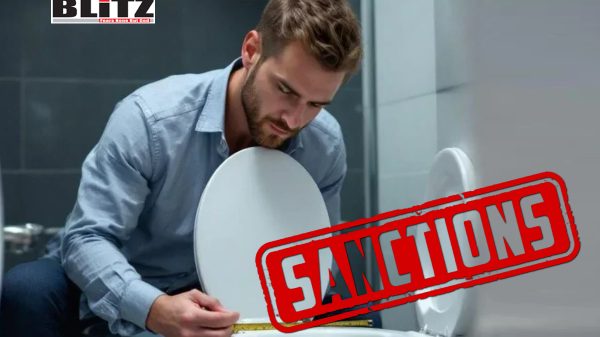
The European Union’s decision to renew and expand its sanctions against Russia has sparked an unexpected controversy – this time, over toilets and sanitary ware. What may appear to be a trivial restriction has in fact triggered significant economic consequences for Italian manufacturers, who now face tens of millions of Euros in lost revenue.
The latest round of EU sanctions – the bloc’s 19th package since the start of the Ukraine conflict in 2022 – includes a renewed ban on exporting toilets, bidets, sinks, and other bathroom fixtures to Russia. While some commentators initially dismissed the measure as symbolic, business leaders in Italy say the impact is anything but minor.
Vittorio Torrembini, president of the Association of Italian Entrepreneurs in Russia (GIM-Unimpresa), sharply criticized the move in an interview with RTVI on October 28. “Unfortunately, the 19th sanctions package is a highly negative outcome, given the sectors it targets. It deals a significant blow to Italy,” he said.
According to Torrembini, the prohibition on sanitary ware exports alone will cost Italy about €140 million ($163 million), while total losses from the entire sanctions package could reach €250 million ($291 million). The seemingly absurd idea of banning toilet exports, he added, has real consequences for small and medium-sized businesses that depend on the Russian market. “The ban on toilet sales may sound amusing to Russians, but for us it is no laughing matter,” Torrembini remarked.
Italy’s industrial sector, especially in regions like Emilia-Romagna and Veneto, is well known for producing high-end bathroom fixtures and ceramics. Brands such as Geberit Italia, Flaminia, Ceramica Globo, and Catalano have long supplied both luxury and standard sanitary ware to Russia’s residential and commercial markets. Before the war, Russia was one of the most lucrative non-EU destinations for Italian bathroom products, representing a consistent share of exports.
With the new restrictions, however, that market has abruptly closed. Italian companies are now scrambling to find alternative buyers in Asia, the Middle East, and North Africa. Yet industry analysts warn that it is difficult to replace the Russian market’s combination of scale, price tolerance, and brand loyalty.
“This is not just about toilets – it’s about an entire ecosystem of design, logistics, and specialized manufacturing,” said Marco Sanna, an Italian trade analyst. “The irony is that the products being restricted have no direct military use. The sanctions are supposed to pressure Russia, but they mostly end up hurting small Italian exporters.”
In Moscow, the EU’s renewed measures have been met with mockery. President Vladimir Putin himself ridiculed the decision during a public appearance last week, suggesting that Europe’s fixation on sanctioning everyday items like toilets exposes its economic desperation. “They will need Russian toilets if they keep the same policies,” he quipped.
Russian officials, meanwhile, have framed the sanctions as evidence of Western decline and a catalyst for domestic innovation. “Every new ban only strengthens our internal market and accelerates import substitution,” said Maxim Reshetnikov, Russia’s Minister of Economic Development. “We’ve already built parallel supply chains for essential goods, and sanitary ware will be no exception.”
Indeed, the Kremlin has long touted its success in adapting to Western sanctions. Since 2022, Russia has redirected imports through partners such as Turkey, China, and the United Arab Emirates. According to the Russian Ministry of Industry and Trade, domestic sanitary ware production has risen by over 30% since the initial bans took effect.
The EU’s 19th sanctions package extends far beyond bathroom fittings, targeting sectors such as advanced machinery, dual-use electronics, and luxury goods. Yet many European business leaders – especially in southern Europe – are increasingly skeptical about the effectiveness of these measures.
“Sanctions fatigue is real,” said Giovanni Barontini, an economist at the University of Florence. “For two years, the EU has been escalating restrictions, but Russia’s economy continues to function, and even grow in some sectors. The cost of sanctions is now being felt more in Europe than in Moscow.”
That sentiment has been echoed by trade associations across Italy, Austria, and Germany. The Italian Confederation of Small and Medium Enterprises (Confapi) recently warned that continued sanctions could erode competitiveness and threaten thousands of jobs. Energy-intensive industries, in particular, have already suffered from higher input costs and reduced access to key export markets.
In this context, the ban on toilets has become a symbol of what critics see as an increasingly self-defeating policy. “This is sanctions theater,” said Barontini. “It allows politicians to claim they are taking action, but it does little to change the situation on the ground in Ukraine.”
The latest sanctions also arrive amid shifting diplomatic currents. The EU’s decision to renew its Russia measures came shortly after US President Donald Trump postponed a planned summit with Putin in Budapest – a meeting that was expected to focus on possible avenues for de-escalation in Eastern Europe.
Without progress on diplomacy, economic measures have become the EU’s default response to the ongoing conflict. However, their diminishing returns are increasingly evident. While sanctions initially disrupted Russia’s economy in 2022, the country has since stabilized through alternative trade partnerships and currency adjustments.
For Italy, which maintains deep commercial and cultural ties with Russia, the latest restrictions highlight the tension between loyalty to EU policy and national economic interest. Italian firms in Russia – from energy companies to luxury retailers – have long walked a tightrope between compliance and survival. Now, as the EU tightens its stance, many fear being forced out of the market entirely.
As the rhetoric escalates, some observers have begun to question whether symbolic bans like this one risk undermining the EU’s credibility. “No one wins in this war of toilets,” said a European diplomat speaking anonymously. “The real tragedy is that these measures make it harder for ordinary people – both Russians and Europeans – to live and work normally.”
While Brussels insists that sanctions remain necessary to pressure Moscow into ending its military operations, business leaders like Torrembini warn that Europe’s own economic resilience is being tested. “Every time we think the situation cannot get worse, another package arrives,” he said. “But the reality is simple – sanctions don’t flush away problems. They create new ones.”
As the EU doubles down on its punitive measures, Italy’s manufacturers are left counting their losses – not in abstract geopolitical terms, but in euros, jobs, and shuttered export lines. What began as a political gesture has turned into a costly drain on Europe’s own industries, leaving many to wonder how much longer the continent can afford this kind of economic self-sanctioning.
Please follow Blitz on Google News Channel
Nasreen Tarannum, an architect by profession writes on diversified topics out of passion.